This is a short addendum to my article Springtime is liver time. Your liver – liver and gallbladder.
I thought it important to touch on bile stones (aka gallstones) – what they are and how and why they can become a problem.
I am going to describe it based on the work of Dr. Natasha Campbell McBride, founder of the GAPS protocol.
The formation of bile stones is perfectly normal and takes place in all of us all of the time.
If you were to cut a bile stone in half and look at it under a microscope, you’d observe a clump of microbes, mineral crystals with toxic metals or other toxins, fragments of parasites and anything else the body is trying to remove.1
When your liver is unable to destroy something it considers dangerous (a toxin, a group of microbes or a parasite), it ‘imprisons’ it by coating it with bile and making a bile stone.
This is a good thing, the way God designed us to function. Initially these stones are tiny and soft; they pass easily through the bile ducts into the duodenum (the upper most part of the small intestine) every time we eat fats.2
Once in the duodenum, the stones make their way through the small intestine to the bowel and get eliminated in the stool.
If a person has been eating processed carbohydrates and low fat foods for a while, then the liver does not get enough stimulation to empty the bile into the duodenum, so the bile stones stay in the bile ducts too long and become calcified.
As the stones accumulate calcium salts on their surface, they get larger and their surface becomes hard and rough, so they cannot pass easily through the bile ducts.3
They get stuck.
As well, when someone has abnormal gut flora and a high parasitic load, they can form too many stones such that the liver can’t flush them out fast enough so they become large and hard.
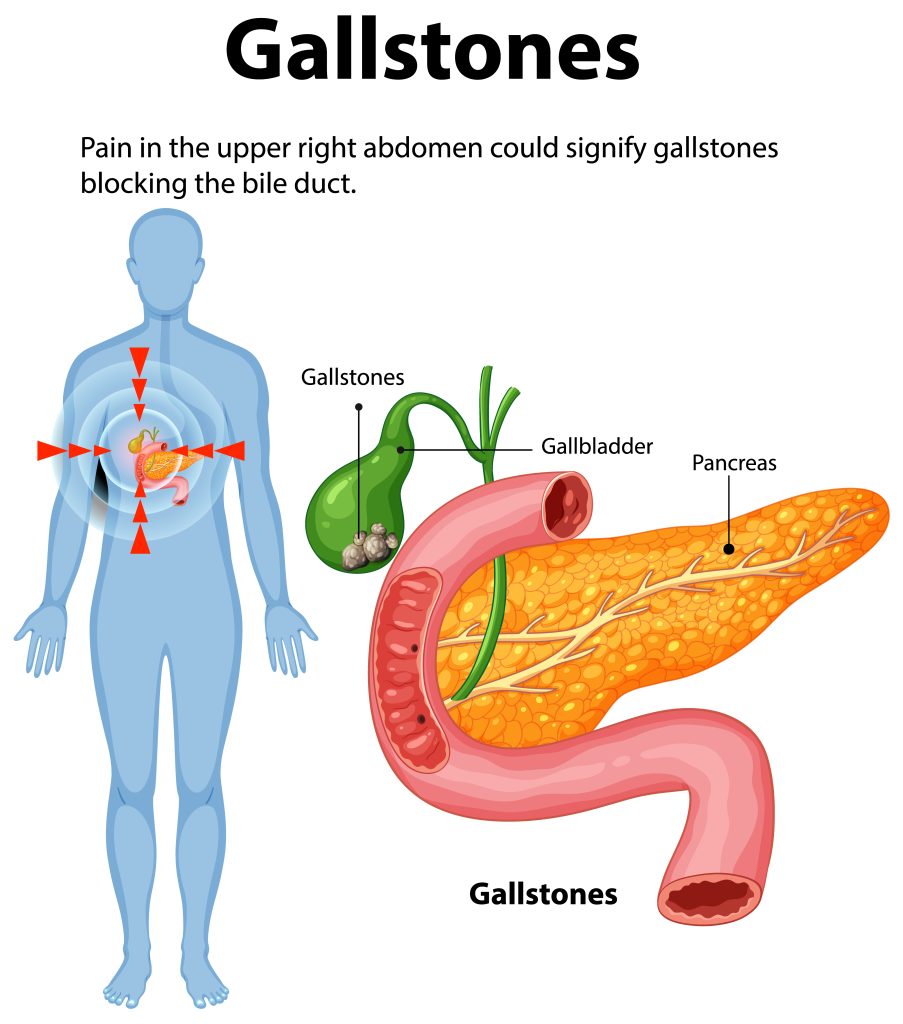
When enough bile ducts are obstructed by stones, the bile flow gets impaired AND the person will not be able digest fats very well.
In addition, if the biliary duct is blocked, it’s possible the flow of pancreatic juices into the duodenum will also be blocked.
For most people the pancreatic duct connects to the biliary duct, forming a shared duct. Hence, the reason pancreatic juices cannot flow into the duodenum when the bile duct is clogged.
This can be very dangerous. It can damage the pancreas and cause acute or chronic pancreatitis.4
For some people the pancreas has another duct opening into the duodenum, independent of the biliary duct, enabling the pancreatic enzymes to reach the duodenum to do their job and lessen the risk of pancreatitis.
Although the enzyme flow will still be impaired if the bile duct is clogged.
Pancreatic enzymes are needed for the digestion of fats, as well as proteins, carbohydrates, and other elements of food.
What do you do to remove bile stones and restore fat digestions?
“GAPS protocol is rich in healthy fats, which stimulate bile production and excretion into the duodenum at every meal.”
It may take time for your liver to get into full gear, but it will do so.”5
GAPS shakes (described in Springtime is liver time. Your liver – liver and gallbladder) will slowly soften and dissolve the hard calcium shell on the stones, while also stimulating the liver capsule to contract and push the stones out.6.
Dr. Natasha also recommends coffee enemas for adults in this situation with excess gall stones.7
“It takes time, but in the majority of patients this situation gets resolved naturally, without any special measures (particularly in children).
In some severe adult cases following Dr Hulda Clark’s Liver Cleanse Protocol may help to eliminate gallstones.”8
Some signs/symptoms that you are not digesting fat well and that you may have enlarged gallstones:
- Fat in stools. Noted by floating or greasy stools.
- Nausea when eating fatty foods, even good quality fats.
- Recurring abdominal pain especially after eating fatty foods.
- Chronic constipation
- Pain in the upper right abdomen
In her book Gut and Physiology Syndrome Dr. Natasha goes into greater explanation of what to do when you have a painful bile stone that’s left the gallbladder and is now in the bile duct…
How to avoid going to the ER, and avoid having your Gallbladder removed.
And what to do if you already had a cholecystectomy.
If you have individual questions or concerns about this topic or other health topic or would like to know more about the GAPS protocol, please feel free to reach out.
Click here to schedule a free 30-minute consultation.
Be well.
Thank you
Karen
The following are some additional gentle ways to support and cleanse the liver and gallbladder.
As always when introducing new protocols, go slowly and listen to your body.
Full disclaimer. I am not a medical doctor. Nothing I am suggesting here should be construed as medical advice. It’s for informational purposes only.
- Eat liver. Either cooked or raw. This will best feed and nourish your liver with the nutrients it needs. You can make liver shots by cutting partially frozen liver into tiny pieces, spread them on a tray, freeze them, put them in a ziplock bag or container. Daily pop one in your mouth. I like to chew them. But if you can’t muster doing so you can just wash them down with water.
- Liver in supplement form.
- Squeeze lemon in your water and drink throughout the day.
- Avoid drinking too much plain water. Natural electrolytes are important for the liver to function. Too much water dilutes electrolytes and can increase their removal from the body through the kidneys. Adding mineral salt to your water will add electrolytes. Natural lacto-fermented beverages also contain good electrolytes.9
- Beet kvass. You can find a recipe here: Karen’s Recipe Page
- Cooked beets and/or beet greens
- Consume sufficient good quality fats at each meal, starting with a small amount and gradually increase.
- Castor oil rubs or castor oil packs. For information and instructions on doing Castor oil Packs, check out Louisa Williams of Radical Medicine.
- Cinchona officionalis (homeopathic remedy)
- Carduus marianus (homeopathic remedy)
- Milk thistle seed capsules or tea. For the tea coarsely grind the seed and seep to make a tea.
- Dandelion root granules or fresh dandelion tea. [Note. If using the granules, make sure your detox pathways are open so they don’t cause too strong of a healing reaction at once.]
- Other herbs such as chicory root, turmeric, peppermint, and greater celandine.
- Acupuncture
1Campbell McBride N. Gut and Physiology Syndrome. Mediform Publishing 2020 pp 77-82
2Ibid
3Ibid
6Campbell McBride N. Gut and Physiology Syndrome. Mediform Publishing 2020 pp 77-82
7Ibid
9Ibid